


ILUVIEN APPROVED FOR A SECOND INDICATION
ILUVIEN APPROVED FOR A SECOND INDICATION
This site is intended for US healthcare professionals only



Case provided with permission by Dilsher Dhoot, MD. This is one patient’s experience. Individual results may vary.
Corticosteroids treat the underlying chronic low-grade inflammation that is driving DME. Treating this inflammation consistently and continuously, beginning early in the course of the disease, can control the edema and may improve anatomical and visual outcomes for your patient.2,3,4
In PALADIN, for patients previously treated with a short-acting dexamethasone implant, the predictive value (PV) of multiple dexamethasone injections was not greater than the PV of a single dexamethasone injection.5
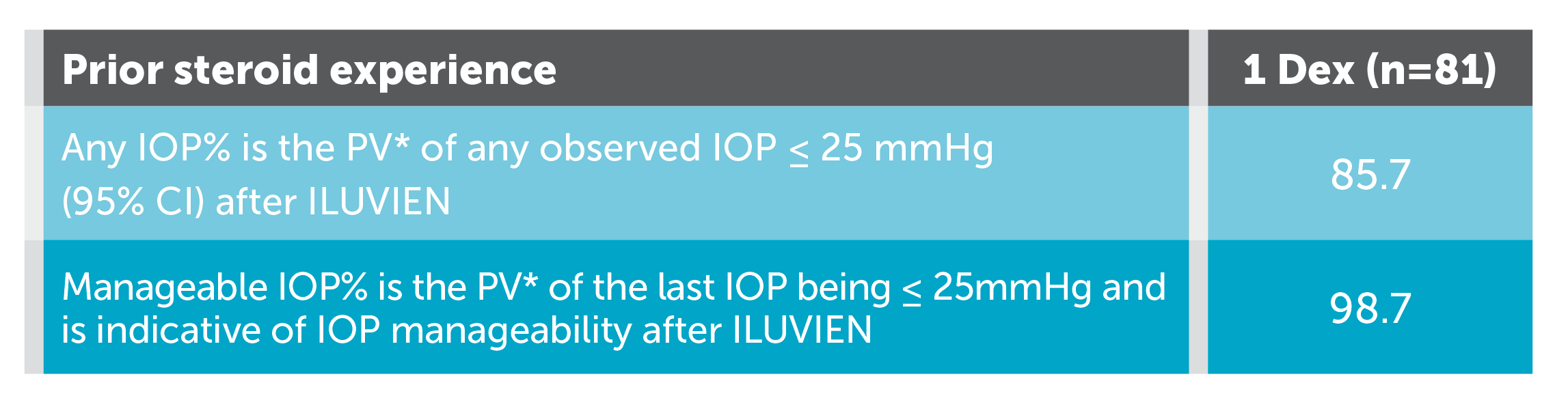
*Predictive Value (PV) describes the probability of an IOP response ≤ 25 mmHg after ILUVIEN, if the IOP response was ≤ 25 mmHg with a prior course of steroid.
Any IOP% for >1 dexamethasone injection was 68.3% and the manageable IOP% was 92.7%.
Contraindications
Warnings and Precautions
Adverse Reactions
Diabetic Macular Edema
Ocular adverse reactions reported by greater than or equal to 1% of patients in the two combined 3-year clinical trials following injection of ILUVIEN for diabetic macular edema include: cataract (82%), myodesopsia (21%), eye pain (15%), conjunctival hemorrhage (13%), posterior capsule opacification (9%), eye irritation (8%), vitreous detachment (7%), conjunctivitis (4%), corneal oedema (4%), foreign body sensation in eyes (3%), eye pruritus (3%), ocular hyperaemia (3%), optic atrophy (2%), ocular discomfort (2%), photophobia (2%), retinal exudates (2%), anterior chamber cell (2%), and eye discharge (2%). Non-ocular adverse reactions reported by greater than or equal to 5% of patients include: anemia (11%), headache (9%), renal failure (9%), and pneumonia (7%)
Increased Intraocular Pressure: IOP elevation greater than or equal to 10 mm Hg from baseline at any visit was seen in 34% of ILUVIEN patients versus 10% of sham patients. IOP elevation greater than or equal to 30 mm Hg was seen in 20% of ILUVIEN patients versus 4% of sham patients. 38% of the patients who received ILUVIEN were subsequently treated with IOP-lowering medications during the study versus 14% of sham patients. 5% of the patients who received ILUVIEN needed surgical intervention for elevated IOP versus 1% of sham patients
Cataracts and Cataract Surgery: The incidence of cataract development in patients who had a phakic study eye was higher in the ILUVIEN group (82%) compared with sham (50%). The median time of cataract being reported as an adverse event was approximately 12 months in the ILUVIEN group and 19 months in the sham group. Among these patients, 80% of ILUVIEN subjects versus 27% of sham-controlled subjects underwent cataract surgery, generally within the first 18 months (median month 15 for both ILUVIEN group and for sham) of the studies.
ILUVIEN is a corticosteroid indicated for:
Please see full Prescribing Information.
Contraindications
Warnings and Precautions
Adverse Reactions
Diabetic Macular Edema
Ocular adverse reactions reported by greater than or equal to 1% of patients in the two combined 3-year clinical trials following injection of ILUVIEN for diabetic macular edema include: cataract (82%), myodesopsia (21%), eye pain (15%), conjunctival hemorrhage (13%), posterior capsule opacification (9%), eye irritation (8%), vitreous detachment (7%), conjunctivitis (4%), corneal oedema (4%), foreign body sensation in eyes (3%), eye pruritus (3%), ocular hyperaemia (3%), optic atrophy (2%), ocular discomfort (2%), photophobia (2%), retinal exudates (2%), anterior chamber cell (2%), and eye discharge (2%). Non-ocular adverse reactions reported by greater than or equal to 5% of patients include: anemia (11%), headache (9%), renal failure (9%), and pneumonia (7%)
Increased Intraocular Pressure: IOP elevation greater than or equal to 10 mm Hg from baseline at any visit was seen in 34% of ILUVIEN patients versus 10% of sham patients. IOP elevation greater than or equal to 30 mm Hg was seen in 20% of ILUVIEN patients versus 4% of sham patients. 38% of the patients who received ILUVIEN were subsequently treated with IOP-lowering medications during the study versus 14% of sham patients. 5% of the patients who received ILUVIEN needed surgical intervention for elevated IOP versus 1% of sham patients
Cataracts and Cataract Surgery: The incidence of cataract development in patients who had a phakic study eye was higher in the ILUVIEN group (82%) compared with sham (50%). The median time of cataract being reported as an adverse event was approximately 12 months in the ILUVIEN group and 19 months in the sham group. Among these patients, 80% of ILUVIEN subjects versus 27% of sham-controlled subjects underwent cataract surgery, generally within the first 18 months (median month 15 for both ILUVIEN group and for sham) of the studies.
ILUVIEN is a corticosteroid indicated for:
Please see full Prescribing Information.

This site is for US audiences only. © Copyright 2025 ANI Pharmaceuticals, Inc. All rights reserved.
ILUVIEN is a registered trademark of Alimera Sciences, Inc., an ANI Pharmaceuticals, Inc. Company.
US-IL-2400025 10/2025
Consider ILUVIEN for phakic patients with DME, particularly those aged > 50 years and/or with developing cataracts
Patients with diabetes are 2 to 5 times more prone to cataract development2
In the ILUVIEN Phase 3 clinical trials:
Observations from a small, real-world cohort of vitrectomized patients with DME treated with ILUVIEN
Authors of this study received compensation from Alimera. Two authors received speaker honoraria from Alimera, and two authors were consultants. One author received reimbursement of travel expenses and study support from Alimera.
FAME A and B were randomized, double-masked, sham injection–controlled, parallel-group, multicenter studies conducted under a single protocol over 36 months.
Study arms:
561 subjects randomized 2:1
Primary endpoint:
Proportion of subjects with improvement in BCVA ≥ 15 letters at 24 months
Inclusion criteria:
Foveal thickness ≥ 250 μm despite ≥ 1 prior focal/grid macular laser photocoagulation treatments and BCVA in ETDRS letter score between 19 and 68 (20/50-20/400).
Exclusion criteria:
Glaucoma, ocular hypertension, IOP > 21 mm Hg, or using IOP-lowering drops.
Reference:
1. ILUVIEN® [package insert]. Alpharetta, GA: Alimera Sciences, Inc.
1. ILUVIEN® [package insert]. Alpharetta, GA: Alimera Sciences, Inc.
2. Parrish RK, Campochiaro PA, Pearson PA, Green K, Traverso CE, FAME Study Group. Characterization of intraocular pressure increases and management strategies following treatment with fluocinolone acetonide intravitreal implants in the FAME trials. Ophthalmic Surg Lasers Imaging Retina. 2016;47:426-435.
1. Meireles A, Goldsmith C, El-Ghrably I, et al. Efficacy of 0.2 µg/day fluocinolone acetonide implant (ILUVIEN) in eyes with diabetic macular edema and prior vitrectomy. Eye (Lond). 2017;31(5):684-690.
1. ILUVIEN® [package insert]. Alpharetta, GA: Alimera Sciences, Inc.
2. Javadi MA, Zari-Ghanavati S. Cataracts in diabetic patients: A review article. J Ophthalmic Vis Rec. 2008;3(1):52-65.
3. Data on file. Alimera Sciences, Inc.
4. Mordi JA, Ciuffreda KJ. Statis aspects of accommodation: age and presbyopia. Vision Res. 1998;38:1643-1653.
5. Campochiaro PA, Brown DM, Pearson A, et al. Long-term benefit of sustained-delivery fluocinolone acetonide vitreous inserts for diabetic macular edema. Ophthalmology. 2011;118:626-635.
6. Yang Y, Bailey C, Holz FG, et al. Long-term outcomes of phakic patients with diabetic macular oedema treated with intravitreal fluocinolone acetonide (FAc) implants. Eye (Lond). 2015;29:1173-1180.
1. Data on file. Alimera Sciences, Inc.
1. Data on file. Alimera Sciences, Inc.